Visitor's Location:

Dedicated To The Memory Of "The Shedden Eight".....

Dedicated To The Memory Of "The Shedden Eight".....
Thanx to the few who left a comment.....

Friday, July 6, 2018

Two biker gang leaders convicted for deadly 2015 shootout

Biker Brawl: Inside waco texas shootout
Three years after the deadly biker gang shootout in the parking lot of a Twin Peaks restaurant in Waco, Texas, the top two leaders of the Bandidos motorcycle club were found guilty on 13 federal charges. Bandidos National President Jeffrey Pike, 62, and Vice President Xavier Portillo, 58, were convicted Thursday by a jury in San Antonio after a nearly three-month trial. Jurors convicted the leaders of the motorcycle organization of racketeering, drug trafficking, conspiracy to commit murder and extortion charges. The men face up to life in prison and will be sentenced later this year.
Prosecutors have dismissed dozens of criminal cases against other bikers who were at the deadly Twin Peaks shootout in May 2015. McLennan District Attorney Abel Reyna decided hours after the shootout to round up all the bikers and charge them with the same criminal count of engaging in organized criminal activity. But that strategy now seems to be unraveling.
Since February, the district attorney has dismissed criminal charges against 124 bikers. On May 9, a McLennan grand jury re-indicted 25 bikers who were at the shootout. Among the new indictments were three murder charges against Bandidos bikers, as well as charges of tampering with evidence and engaging in first- and second-degree riot. The federal investigation into the Bandidos leadership was not part of the Waco shootout investigation. The Federal Bureau of Investigation was already working with the Drug Enforcement Agency, building its case against the outlaw motorcycle gang. The Twin Peaks shootout was the violent ending to a boiling feud between the Bandidos and the Cossacks biker clubs. Cossacks bikers have told CNN that they came to the Twin Peaks to make peace. The Bandidos say the Cossacks showed up in massive numbers that morning to ambush them. Nine people were killed and dozens more injured and wounded on that Sunday morning. Investigators carried out an unprecedented roundup and charged 177 bikers. The handling of the Waco shootout cases has been highly controversial and described as "embarrassing" and a "frontal assault" on the biker's rights. "This incident serves as an abject lesson to prosecutors that, in America, you are supposed to investigate first and charge later; not the other way around," attorney Clint Broden, who represented three bikers, said in a statement. The federal case against the Bandidos leaders has loomed heavily over the Waco prosecution. Federal prosecutors alleged that Pike and Portillo sanctioned years of violence against rival biker gangs in order "to protect the power, reputation and territory of the Bandidos enterprise." Prosecutors also argued that Pike approved a declaration of war on the Cossacks biker club that ultimately led to carnage at Twin Peaks. "This effort demonstrates our ongoing commitment to prevent gang violence and criminal activity from poisoning our communities. It also sends a clear message that we will relentlessly pursue and prosecute the leaders and members of these violent criminal enterprises," FBI Special Agent in Charge Christopher Combs said in a statement after the verdict. Pike, the national president of the Bandidos from 2005 to 2016, was featured exclusively in the CNN documentary "Biker Brawl: Inside the Texas Shootout." In the CNN interview, Pike, who was not at the Twin Peaks during the shootout, dismissed the accusations of declaring war on the Cossacks with a laugh and said he had not committed a crime in decades. "They (investigators) asked me that in my interview when they arrested me," Pike told CNN. "I laughed and I said, 'How do you do that? It's an act of Congress to declare war. Do we write them a letter or what?'" Pike had stepped down as national president shortly before the CNN interview. In November, the only Waco case that has gone to a jury ended in a dramatic mistrial. The jury could not reach a unanimous verdict in the case of Jake Carrizal, the president of the Dallas Bandidos chapter. Carrizal was one of the first Bandidos bikers to arrive at the Twin Peaks restaurant and was in the middle of the fight. "They weren't there to chit-chat. They were on a mission. They were there to confront us," Carrizal told CNN for the documentary. "They were attacking. And I was fighting for my life." Carrizal is one of the Bandidos bikers who has been re-indicted by a McLennan grand jury and now faces a first-degree riot charge. He faces up to life in prison. His new trial is still pending. The Bandidos are considered part of the 1% outlaw biker world. It's a label that has repeatedly made the club's members targets of law enforcement investigators. Law enforcement investigators say 1% clubs, especially the Bandidos, operate as criminal street gangs and live "to instill fear and intimidation" in their rivals.

Jeff Pike, Texas’s Own Tony Soprano

Earlier this spring, Jeff Pike, the head of the infamous Texas-based Bandidos motorcycle club, went on trial in federal court for racketeering. Prosecutors called him a ruthless killer, the man behind one of the deadliest biker shootouts in American history at the Twin Peaks restaurant in Waco. Pike, however, said he was just a good family man. On Thursday, jurors announced their verdict.
In 2007, when I first met Jeff Pike, he had just finished an eleven-mile bicycle ride. He was wearing shorts, a T-shirt, and tennis shoes. We were at his two-story home that he had built on some secluded property five miles outside of Conroe, north of Houston. He was a good-looking guy, then 51 years old, and he wore his salt-and-pepper hair in a crewcut. As he handed me a bottled water, he gave me the most cheerful of grins. “Not what you expected, huh?” he asked. Not exactly. At the time, I was told by law enforcement officers that Pike was Texas’s Tony Soprano, a ruthless criminal who led the Bandidos with an iron fist. One undercover agent with the Department of Public Safety warned me to be very careful around the Bandidos’ boss. “The last thing you want to do is get on his bad side,” he said. Yet Pike simply shrugged as I asked him about the various allegations that had been thrown his way—including a recent report that he even had ordered the executions of some wayward Bandidos in Canada who hadn’t been following club rules. “It’s ridiculous,” he said. Pike liked to describe himself as an ordinary guy: a divorced father whose two children attended the University of Texas. He said he got up early in the mornings, made the bed, walked the dogs, spent time restoring custom cars in a fabrication shop on his property, rode his bicycle to stay in shape, took his new girlfriend (a certified public accountant) to the movies, and occasionally participated in weekend “runs” (motorcycle trips) with his fellow Bandidos. “Why can’t the feds just accept the fact that we are a bunch of bikers who love to get together and have some fun?” he said, tossing his empty bottled water into a trash can. “Why don’t they start chasing real criminals, like those kids in street gangs who scare the shit even out of me, instead of following us everywhere we go, tapping our phones, and trying to destroy us with a bunch of made-up charges?” I have to admit, I enjoyed the heck out of him. When I later met him for dinner at Kirby’s, the upscale steak restaurant in the Woodlands, he roared up on a gleaming Harley Davidson and strolled into the restaurant wearing his “colors” (a dark, denim Bandidos vest). I felt like I was dining with a celebrity. People slowed past our table to get a good look at him. We talked about noncriminal matters—sports and politics—and after eating his steak and having one drink, he left at 9:30, telling me he had to get home because he liked going to bed by 10 p.m. “This man is a vicious killer?” I asked myself. Over the next several years, I’d hear rumors that Pike was the subject of a federal investigation. But the stories were just that—nothing more than rumors. Pike seemed to be untouchable. Then, in January 2016, a couple of dozen federal officers drove up to Pike’s wrought-iron front gate (which had a Christmas wreath attached to it), stared at the security cameras mounted in trees, and ordered Pike through a loud speaker to let them in. At the same time, other agents and officers arrived at the San Antonio home of the Bandidos’ national vice president, Jorge Portillo. Pike and Portillo were arrested on racketeering and conspiracy charges. According to prosecutors from the U.S. Attorney General’s office, Pike had issued secret orders to Portillo about assaults and murders he wanted carried out in order to maintain control of the club’s territory and profits, and Portillo, in turn, had ordered certain Bandidos to commit those crimes. In particular, the prosecutors said, Pike had ordered hits on bikers from other motorcycle clubs, including an Austin man who was trying to start a Texas chapter of the California-based Hells Angels motorcycle club, one of the Bandidos’ chief rivals. Pike also allegedly had authorized a war on the Cossacks, a smaller Texas-based motorcycle club that had dared to challenge the Bandidos’ reign. That war, of course, had culminated in the now-infamous May 17, 2015, gun battle involving Bandidos and Cossacks at a Twin Peaks restaurant in Waco. When the shooting finally stopped, nine bikers had been killed, seven of them Cossacks. Dick Deguerin, the well-known Houston defense attorney who represented Pike, dismissed the indictment as rubbish, declaring that prosecutors were trying to make Pike responsible for the behavior of some renegade Bandidos. Yes, Deguerin acknowledged, there were Bandidos who had committed crimes while Pike was president, but he had no idea what they were doing. And he certainly hadn’t instructed anyone to break the law. “The Bandidos are not a criminal enterprise,” Deguerin said. “They are about fellowship. Their primary purpose is that they love motorcycles and the freedom that motorcycles give a person.” In the same vein, San Antonio attorney Mark Stevens portrayed his client Portillo as a family man who owned a small company that installed heating and air conditioning units and who liked riding with the Bandidos on weekends to relax. Nevertheless, prosecutors were confident they had the evidence to bring down Pike and Portillo. They not only had received a court order to tap Portillo’s cell phone, they also had persuaded eight Bandidos and former Bandidos to testify about the inner workings of the organization. The trial began in late February in federal court in San Antonio. Every day, the jurors, whose names were kept secret, were bussed to the courthouse from an unknown location, accompanied by armed guards. After they took their seats, they glanced at Pike, who’s now 62, and at Portillo, who’s 58. Pike always wore a nice dark suit, a white shirt, and a tie, and Portillo wore a dark shirt and a sports coat. At the defense table, the two Bandidos looked like harmless, aging businessmen meeting for lunch.
During my conversations with Pike, he often told me that he knew “the feds,” as he called FBI and DEA agents, were doing their best to put him behind bars. “I once had a cup of coffee with an FBI agent at a Denny’s and he said, ‘You know, Jeff, we’re looking at you.’” “So why be president?” I asked him. “Why be a Bandido at all?” He gave me a look, as if he sort of pitied me. “If you have to ask, then you’ll never understand,” he said. The Bandidos were formed in 1966 by a former Vietnam veteran named Don Chambers, who was then 36 years old and working on the ship docks in Houston. Chambers had been a member of other Houston-area motorcycle clubs, but they had bored him. He told his friends that he was naming his club the Bandidos in honor of the Mexican bandits who refused to live by anyone’s rules but their own, and he made it clear that this was not going to be a club for anyone who belonged to what he called “polite society.” Chambers recruited his first Bandidos not only out of Houston but out of the biker bars in Corpus Christi, Galveston, and San Antonio. Many of them were also restless young Vietnam veterans, and they loved the Bandidos. As I wrote in an April 2007 article, “The Gang’s All Here,” they had wild, unruly hair, scraggly beards, huge tattoos, and cigarettes sticking out of their mouths, and they went by such nicknames as Revolver, Pecker, Deadweight, Rawhide, Coonass, and Crankcase. One member was nicknamed Log Cabin because he loved drinking whiskey from a Log Cabin syrup bottle. They quickly developed a reputation as Texas’s biggest bad-asses, self-proclaimed outlaws who loved the open road. They were arrested for dealing drugs, running prostitution rings, extorting money from the owners of roadhouses and strip joints—even operating illegal pit bull fights. They also ran roughshod over other biker clubs, telling them that they controlled Texas, going so far as to make the other clubs pay dues to ride the state’s highways. The Bandidos also made it clear to those clubs that only Bandidos had the right to wear a “Texas rocker:” a semi-circular patch on the back of their vests that read, “Texas.” When Chambers went to prison in 1972—he was convicted of a double murder near El Paso for settling a score over a drug deal—he was replaced by his right-hand man, Ronnie Hodge, another former Houston dockworker who was the size of a grizzly bear. In 1988, Hodge and other Bandidos national officers were convicted in federal trial conspiring to bomb homes and automobiles belonging to members of the Banshees, an upstart Dallas motorcycle club. Hodge’s successor, Craig “Jaws” Johnston, was found guilty of conspiring to manufacture and sell as much as a thousand pounds of methamphetamine, and Johnston’s successor, George Weggers, went to prison on racketeering charges. In 2005, the Bandidos national officers picked Pike to be the club’s fifth president. Pike grew up in California. He was an altar boy at a Catholic church until he realized he preferred hanging out at an arcade playing pinball. He came to Texas in 1973, when he was eighteen years old. (“I was told it was legal to drink beer in Texas at eighteen and I said, ‘I’m on my way.’”) He got a job in construction, bought a Harley in 1975, began hanging around some Bandidos, and was officially invited into the club in 1979. Pike told me, “When my best friend’s mother heard I had joined, she got real scared and said, “You’re not going to kill me, are you? I heard new Bandidos have to promise that they will be willing to kill their best friend’s mother.” Pike admitted that he did get into a few fights as a young Bandido. He once rode to Galveston with other Bandidos to beat up some rival bikers who were causing problems at a topless club that the Bandidos liked. In 1987 he paid an $800 fine after pleading guilty to a misdemeanor assault charge (he admitted stabbing a man who was arguing with him at a party), and in 1992 he received twenty months deferred adjudication after being charged with illegally wiring his house in order to steal electricity from the city of Houston. But those were the only two crimes on his rap sheet. Compared to other unruly Bandidos, he was a clean-cut yuppie. Perhaps that’s why he was named president. Because he got along so well with polite society—(one FBI agent would later say at a court hearing that he always found Pike to be “cordial” whenever they talked)—the thinking was that he would be able to persuade the feds to stop snooping around. Pike did instill some reforms. He demanded that his fellow Bandidos stop describing their girlfriends as “property.” He had some members kicked out for drug dealing and had other members kicked out for what he described as “bad conduct.” To avoid drawing attention to himself, he did away with the large “El Presidente” patch worn on the back of the national president’s vest and replaced it with a small patch over the front pocket that simply read, “president.” When Pike gave interviews to the press, he liked to say, “We are not your father’s Bandidos.” He described his members as men who steered clear of the law, worked good jobs, bought braces for their kids, and wore khakis and golf shirts when they weren’t riding their motorcycles. He always mentioned that he too was living a crime-free life. He had married his accountant girlfriend. They vacationed on cruise ships together and posted pictures on Facebook. At Christmas, he did toy runs with other Bandidos, delivering presents to needy children. “We are not a threat,” he once told me. “You leave us alone, and we’ll leave you alone.” Under Pike, the Bandidos grew in size, becoming larger than the fabled Hells Angels. It consisted of an estimated 2,000 members in sixteen states (about 600 in Texas alone) and another 1,400 members in Canada, Europe, and Australia. The feds, however, just chuckled at Pike’s talk about the club softening its tough-guy persona. They also suspected that Pike himself was up to some sort of no-good. For one thing, he was extremely cautious about the people he allowed to get close to him. He seemed so anxious about undercover cops infiltrating the club that he had instilled a strict screening process requiring members who sponsored a new “prospect” to have known that person for at least five years. The feds really got interested in Pike in 2006, when an Austin biker named Anthony Benesh III began displaying Hells Angels colors as he rode the streets. He was warned by Austin-based Bandidos to stop, but he ignored them. On a Saturday evening in March 2006, Benesh was shot in the head by a sniper’s rifle bullet as he was walking out of a restaurant with his girlfriend and his two sons. Surely, investigators said, a Bandido would not have carried out such a highly public hit on his own. Surely, Benesh’s murder had to have been sanctioned by the club’s boss. But the investigation went nowhere. Then, in late 2013, word circulated through law enforcement circles that the Bandidos were going after the Cossacks, a younger Texas-based motorcycle club that in the words of biker expert Donald Charles Davis (who blogs under the name The Aging Rebel) was “aiming to gain notoriety.” Some Cossacks had been seen wearing the “Texas rocker” on the back of their vests, which the Bandidos considered a deliberate provocation. To members of polite society, grown men feuding over a patch seems, well, comical. But in the biker world, being treated with respect is of paramount importance. And as far as the Bandidos were concerned, the Cossacks needed to be punished for their disrespect. A number of clashes or confrontations between the two biker clubs soon broke out around the state. At a gas station in West Texas, about twenty Bandidos and their associates attacked a Cossack and took his vest. One Bandido beat the Cossack with a claw hammer, leaving deep gashes in his head. In Fort Worth, at least ten Bandidos stormed into a bar called Gator’s that was known as a Cossack hang out. The Bandidos were carrying clubs, large heavy flashlights, and at least one gun. A melee broke out and one biker, a member of a Cossack support club, was shot to death. Agents from the DEA and FBI decided to make their move. They confronted Johnny “Downtown” Romo, a former national officer for the Bandidos who lived in San Antonio and was close to Portillo. They told Romo they were prepared to arrest him on drug trafficking charges, but they promised to drop the case if he would agree to wear a wire to his meetings with Portillo. In the Bandido world, loyalty to the club is highly prized. (Some Bandidos have bumper stickers on their motorcycles that read, “Shoot Informants Not Drugs” and “Snitches Are A Dying Breed.”) Members suspected of snitching are not only kicked out of the club—they are brutally beaten and their Bandidos’ tattoos are forcibly removed. Incredibly, however, Romo decided to betray his fellow Bandidos. He put on the wire and agents listened in as Portillo told Romo, “We’re not going to f— around with them Cossacks, dude. It’s on. Our patch, our club, is at war with these f—ers.” During that same conversation, Portillo also said he planned to increase membership dues to help pay legal costs for Bandidos members who might end up in legal trouble for fighting the Cossacks. He then said that he had informed “the guy in Houston to turn his back from what I’m going to do.” Obviously, the feds believed, the guy in Houston was Pike. Portillo had informed Pike to turn his back so that Pike could claim ignorance of the plans to attack the Cossacks. After the May 2015 Twin Peaks shootout, which was described in Washington Post as “one of the worst eruptions of biker-gang violence in U.S. history,” I again interviewed Pike for a July 2015 story, “Gang Land.” He told me he knew nothing about what had taken place in Waco. He had been laid up in bed, he said, recovering from surgery. “Hell, no, I didn’t order any hit,” he said. “We don’t do shit like that. And we sure as hell wouldn’t do something like that in front of cops.” At the time, what I didn’t know was that the feds had received a secret court order to wiretap the cell phones of Portillo and Justin Cole Forster, a national sergeant-at-arms in charge of enforcing the Bandidos’ rules and handling security at Bandidos’ gatherings and meetings. On top of that, the feds had begun putting the squeeze on a handful of Bandidos they had arrested for various crimes, offering them lighter sentences in return for their testimony about the way Pike and Portillo ran the club. The stories eventually piled up. Portillo, said those Bandidos who had cut deals, acted as a buffer between Pike and the rest of the club, but Portillo definitely had let it be known that Pike was in charge. They said Portillo had told them that Pike had ordered the execution of Benesh, the Hells Angel in Austin, and that Pike had told Portillo to send Bandidos to intimidate and attack other rivals. And there were rare occasions, they said, when they heard from Pike himself. Johnny “Downtown” Romo said that Pike had told him to deal with a recalcitrant chapter president of the Australian Bandidos. “I don’t care what you do,” Romo quoted Pike as saying. “Throw him in the ocean, do whatever the f—k you gotta do.” Another Bandido, William “Big G” Ojemann, who was 6′ 3″ tall and weighed 420 pounds, said he had attended a meeting in 2011 at the Mason Jar restaurant in Houston in which Pike got angry at “Galveston John,” the Bandidos’ chapter president in Costa Rica, for openly disagreeing with him about an issue. Ojemann said as he rode with Pike back to his house, Pike was in a rage. “I remember him turning down the radio and saying he wanted Galveston John’s (the Costa Rica chapter president) ass,” Ojemann said. “He was pissed. He wanted Galveston John f—ed up.”
In truth, the feds had no direct evidence that Pike was involved in any crime, nor did they have him on a wiretap making incriminating statements. But under the federal racketeering statutes (which has less-strict hearsay rules than normal criminal cases), prosecutors from the U.S. Attorney’s office were still able to make a case on Pike based almost entirely on the stories told by the Bandidos they had flipped. At the trial, those Bandidos hesitantly made their way to the witness stand. They could barely look at Pike and Portillo. They knew the consequences they faced for their betrayal. One of them, in fact, testified that he had begged the federal prosecutors to place him in the witness protection program “because there’s no way I can live in San Antonio after this. What I did is unforgivable.” Asked what he did, he replied, “snitching.” Although Portillo did not testify in his defense, Pike gladly did. He said his goal as president had been to attract more mainstream and family-oriented members—“different, younger people, more settled, I guess you would say.” He insisted he was unaware of any beatings or murders of rivals or of fellow Bandidos, and he was especially adamant that he didn’t sanction a “war” against the Cossacks. He said he went so far as to inform the Cossacks leaders that they could wear the Texas patch. “I like it when everybody gets along,” Pike said. “I don’t like drama.” Pike held his ground during cross-examination, calmly answering questions from Assistant U.S. Attorney Eric Fuchs. The only moment when Pike almost lost his composure was when Fuchs asked him to define a snitch. Pike snidely replied that a snitch was “a witness who makes up stories to get himself out of trouble.” In final arguments, Deguerin told the jury that there was still no evidence connecting Pike to any assault or killing. Pike was a family man, said Deguerin. He soon would be a grandfather. But Fuchs went on the attack. Under Pike and Portillo, he declared, the Bandidos were “the Mafia on two wheels.” On Thursday, May 17, after two and a half months of testimony, the jurors came back with a verdict. Pike and Portillo, they said, were cold-blooded killers, guilty of all charges that had been levied against them. The judge said he would announce Pike’s and Portillo’s sentences later this fall, and then he gaveled the trial to a close. The two Bandidos remained stoic as they were handcuffed and led away. Deguerin, who rarely loses, seemed devastated by the jury’s decision. “I truly believe Jeff is innocent,” he told me. Deguerin knows that under federal sentencing guidelines, Pike is most likely going to receive a life sentence without the possibility of parole. He’s never going to see the light of day again. “But here’s the thing about him,” Deguerin said. “When we talked after the verdict, his biggest worry was about his wife Heather. They had stayed in his RV during the trial, and he was worried that she might have trouble driving it back to their home.” There was a silence. “Think about that,” Deguerin finally said. “Instead of worrying about his own future, he was worried about his wife’s safety. You have to admit that’s pretty remarkable.”

Wednesday, December 3, 2014

New Bandidos Colors For North America

Translated from Dutch..... Bandidos Divide into 2 Clubs, East & West. Controversy and bad blood has caused the Bandidos biker club to divide into two sections. The original of North America and the rest of the world. 22. Sep. 2011 kl. 06:00 The worldwide biker club, the Bandidos, have split. The division caused deep disagreements and bad blood between the original American motorcycle club and branches in Europe, Asia and Australia, learns BBC News. The partition has split the international Bandidos into two clubs. They still use both the name Bandidos. In North America, the Bandidos are now the "Western Hemisphere", while the rest of the world belongs to the "Eastern Hemisphere". - We have followed this closely in recent months and are in close contact with our international partners when it comes to changes in Bandidos internationally. It is our assessment that the split happened because Bandidos internally have acknowledged that they can not control the world club centrally. Therefore, We made a regional breakdown, says Kim Kliver who as head of the National Police National Investigation Centre (NEC), continually monitors rockers throughout Denmark. Meaning in Denmark It's hard to say anything definite about what the international sharing means for the bikers in Denmark and the ongoing gang conflict. But it comes at a critical time: Right now Bandidos and their old rivals the Hells Angels are in a series of clashes in several places in the country - especially in Esbjerg. Until now, the conflict has raged with fists and bats, but the situation is closely monitored because both the bikers and the police fear that the conflict could escalate. - With the knowledge we have now, we do not believe that this pushes the situation in Denmark. But we follow the course carefully, says Kim Kliver BBC News Problem for the Danish management In biker suggests DR News sources, however, that the division has a negative impact on the management of the Bandidos in Denmark. The president, Jim Thindahn is not only head of the Bandidos in this country - but throughout Europe. He greatly enjoyed his legitimacy as leader because he had the original Bandidos in the United States in the back. This backing he is now lost - and thus at a critical time for the Danish biker club. Physically, you can see the sharing of the Bandidos, because one half of the team has changed rygmærket. To change a rygmærke is unheard of in the biker. Normally, the club's brand is something a Biker will go far to defend - and in some cases are willing to die for. Many bikers have the club's brand tattooed right on his back under the vest, and most deceased members of the Bandidos have tombstones with the old logo. So the change of the Bandidos rygmærket correspond in the biker world closest to change the structure of the Dannebrog. Specifically, what has happened is that the Americans have changed their Logo. The famous and notorious Mexican bandit with sombrero hat was changed out with a gun, and his features became more detailed. In Denmark, as in the rest of the "Eastern Hemisphere" they retained the old logo. In time for two months It may seem preposterous that it is the original club who have changed the logo. But according to DR News sources, because it is a recognition that it would be almost impossible and certainly very bloody to travel all around the world and try to tinker rygmærkerne of the thousands of bikers who are in "Eastern Hemisphere". At Bandidos in Denmark have not much to add: - This is an internal Bandidos matter and not something we would comment on, says Michael Rosenvold from club management.

Saturday, January 19, 2013

Vagos biker gang sets up in Peterborough

October 30, 2012..... The Vagos, an American biker club, have arrived in Canada and have apparently set up their first national club in Peterborough. A member of the club, who asked that his name not be used, told The Examiner that the club is at least 23 members strong, with four prospective members waiting on the sidelines.
The Vagos have gained an infamous reputation in the southwestern United States, where they’ve engaged in two shootouts with their rivals, the Hells Angels. The club has also been at odds with the Outlaws, another biker club. The local Vagos member said the club is planning to sit down with the Angels next week to broker a peace deal between the two groups. “We’re not looking for a war in Canada,” he said, adding that the Vagos respect members of the Hells Angels and the Outlaws. Members weren’t going to go out and start intimidating people, he said, but he cautioned that the club was strong, wasn’t prepared to back down and wouldn’t be run out of town. He was referring to the animosity between members of the newly formed club and the Loners. Some members of the Vagos split with the Loners this summer, creating an unresolved rift that has led to violence in the past. One member of the Loners was taken to the hospital in July after a fight broke out near the rail tracks on Park St. Weeks later another man told police that his “Support Your Local Loners” shirt was ripped off his back after he was confronted by three men in the parking lot of Home Depot. The Vagos member said the latter allegation was a concocted story. He also said the club wasn’t involved in any crime. But Peterborough is a city known for its drug trade, he said, and other clubs may find that alluring. “We’re a 1% club, a bunch of guys who love to ride and love the camaraderie,” he said. The Vagos tried setting up in Ontario about five years ago in Toronto. That club quickly fizzled out after it attracted more police attention than it did members. The man said members of the new chapter live around the Peterborough area. “It makes sense to have a stronghold on a city when most of the people are from here,” he said. He said it’s taken about six months to pull the club together. Their clubhouse is located at the corner of Park and Perry streets. The club had to be approved by the American Vagos, he said, and the patches were made and sent from the United States. Residents can expect to see Vagos colours in the city within the next week or so, he said. City police Insp. Ted Boynton said there have been rumours about the Vagos emergence in Peterborough for several months. He didn’t know the club had arrived in Peterborough, but confirmed the colours worn by the member were legitimate Vagos patches. The situation was concerning, he said. http://www.thepeterboroughexaminer.com/2012/10/30/vagos-biker-gang-sets-up-in-peterborough

Local members of the Vigilantes join Loners outlaw motorcycle gang

Local members of the Vigilantes join Loners outlaw motorcycle gang.... October 26, 2012 ..... Members of the Vigilantes have merged with the Loners motorcycle club, bolstering the numbers of the local Loners branch to as many as 30 members. The Examiner has learned that the Loners absorbed their new members about a month ago, during an event referred to among bikers as “patching over,” where one club absorbs members from another club. The Vigilantes have been making occasional appearances in the city since November 2010, when the Outlaws motorcycle club first opened a clubhouse on Lansdowne St. W.
City police Insp. Ted Boynton said investigators have heard rumours about the merger, but weren’t sure if had taken place yet. Nothing changes the way police continue to operate, he said. Officers will continue to monitor the situation. Det. Sgt. Len Isnor, with the OPP’s biker enforcement unit, said the OPP haven’t seen Vigilantes in Loners colours. But he said he wouldn’t be surprised if the two clubs had merged. Isnor pointed out that one club operating in the city is better than two rival clubs fighting for the same territory. “When you have more than one, that’s where the problem starts,” he said. The city has seen its fair share of problems when it comes to rival biker gangs. The Outlaws, who arrived in the city in November 2010, were kicked out of their Park St. clubhouse, located north of the YMCA, a year later by members of the Loners motorcycle club. The club made the news again in June when member Bob Pammett parted ways with the Loners and set up his own clubhouse located at Park and Perry streets. The two clubhouses were mere blocks from one another, and their relationship quickly soured. In July the Loners clubhouse was targeted by men who smashed windows and sprayed a substance akin to bear spray inside the house. Hours later a member of the Loners was taken to the hospital with a serious injury to his arm after he was attacked near the rail tracks on Park St. Pammett was charged in August along with Pierre Aragon after a man told police his “support your local Loners” T-shirt was ripped off his body while he walking through the parking lot near Home Depot. Weeks later Pammett was allegedly the targeted by assailants who threw a Molotov cocktail near the George St. home he was staying at. The merger between the Vigilantes and the Loners marks an upturn in biker-related news, which has been relatively quiet since Pammett moved to Campbellford. http://www.thepeterboroughexaminer.com/2012/10/26/local-members-of-the-vigilantes-join-loners-outlaw-motorcycle-gang

More bikers arrested in beating

November 28, 2012..... City police have arrested two rival bikers in connection with the violent beating of a Loners Motorcycle Club member in July. A 47-year-old member of the Loners was taken to the Peterborough Regional Health Centre with injuries to his arm after he was attacked July 22 near the rail tracks on Park St., police said. Police have now arrested four people in connection to the assault, three of whom are previous Loners members now in “bad standing” with the club, police said. Garry Coppins, a 53-year-old Minden resident who has been living in Peterborough, was arrested Wednesday and charged with aggravated assault, assault with a weapon and possessing a weapon dangerous to the public. Police also arrested Chris Graham, 40, Wednesday at a Perry St. home and charged him with aggravated assault, assault with a weapon and possessing a weapon dangerous to the public. Both Coppins and Graham are former members of the Loners and are now associated with the new Vagos Motorcycle Club in Peterborough, which has a clubhouse at the corner of Park and Perry streets. Det. Sgt. Len Isnor, with the OPP's biker enforcement unit, said the July assault was likely linked to a split within the local Loners chapters. There are now two rival gangs – the Loners and the Vagos – operating in the city. Whenever two gangs are competing in the same territory, there is always the potential for violence, Isnor said. “Outlaw motorcycle gangs are very territorial. You have an outlaw motorcycle gang, the Loners, that are wearing their insignia and a group that was part of the Loners that have broken away. I guess there are some hard feelings,” he said. “There is always the possibility of violence, but we’re prepared. We’re going to stay on top of this. We know who they are and we know where they are.” But given the alleged assault took place before the Vagos officially opened a chapter here, Isnor said he’s not expecting to see any retaliatory violence. “The incident happened before the group became the Vagos, so to be fair, I’m not really sure that it will spark any further incidents,” he said. “We have taken all the precautions. We are watching these guys like a hawk.” The more likely scenario is that the two groups will find a way to work together, Isnor predicted. “The landscape of outlaw motorcycle gangs changes all the time. These guys, one week they’re enemies, the next week they are friends,” he said. “Eventually it comes down to the point that they have to make money. How do they make money? They have to co-exist. Once they get their hurt feelings taken care of, it is going to come down to a point where it’s just business.” That business is usually drugs, Isnor added. “We’re doing everything we can to prevent that from happening. We don’t want a flood of drugs into Peterborough,” Isnor said. “I think we have been keeping a good grip on the situation in Peterborough since all this outlaw motorcycle activity started.” Graham was scheduled to appear in court Wednesday (Nov. 28) while Coppins will appear for a bail hearing Thursday (Nov. 29). Police previously arrested two people, a former Loners member and a former Loners associate, in August in connection to the same assault. Pierre Maurice Aragon,30,was charged with aggravated assault, assault with a weapon, possession of a dangerous weapon and uttering threats. Shane Alfred Gardiner,46,was charged with aggravated assault.
Two former members of the Loners charged in connection with July 22 assault....... August 22, 2012..... Two former members of the Loners have been charged with a violent attack on a current member of the Loners Motorcycle Club. A 47-year-old member of the Loners was taken to the Peterborough Regional Health Centre with injuries to his arm after he was attacked July 22 near the rail tracks on Park St. Pierre Maurice Aragon, 30, was charged with aggravated assault, assault with a weapon, possession of a dangerous weapon and uttering threats. Police charged Aragon when he appeared in court Wednesday morning. Shane Alfred Gardiner, 46, of no fixed address, was charged Tuesday with aggravated assault. He appeared in court Wednesday and was remanded to custody. Police said both men are members in bad standing. That means they’ve been tossed out of the Loners and can’t join another motorcycle club until they’ve resolved their differences with the Loners. These new charges are a triple whammy for Aragon, who’s already facing charges in two separate cases. Aragon was in court Wednesday to speak to charges relating to an Aug. 2 robbery that took place in the Home Depot parking lot. During that altercation a man wearing a “Support Your Local Loners” shirt had the shirt forcibly taken from him. He was also charged during Project Kingfisher, a police investigation into the heroin and cocaine trafficking in Durham region and the city. Aragon was charged with conspiracy to commit robbery, possession of heroin for the purpose of trafficking, possession of cocaine for the purpose of trafficking and possession of crack cocaine for the purpose of trafficking. http://www.thepeterboroughexaminer.com/2012/08/22/two-former-members-of-the-loners-charged-in-connection-with-july-22-assault

New book argues some men in Bandidos deaths wrongly convicted

Jane Sims, QMI Agency... Friday, April 20, 2012.... LONDON, ONT. - Three years after six men went on trial charged with the biggest mass murder in Ontario history, a new book by a trial observer has hit store shelves. Bloody Justice by Anita Arvast, a professor of literature and cultural studies at Georgian College in Barrie, argues that some of the men convicted of killing eight Bandidos bikers were wrongly convicted. Her focus is aimed mostly at Brett Gardiner, the man who had some of the lightest duties in the plot to kill the No Surrender Crew from Toronto. Arvast was frequently at the trial and keenly interested in the plight of Gardiner, who was convicted of two counts of manslaughter and six of first-degree murder. At one point during the seven-month trial, Arvast was banned from the courtroom by court security after she passed reading materials to Gardiner. In the book, she describes Gardiner as “a handsome and good-humoured young man with large gentle brown eyes.” “One knew from his eyes and his demeanor that he really wasn’t the tough guy he wanted others to think he was,” she wrote. Even though Gardiner didn’t shoot any of the Toronto Bandidos, a jury agreed with the Crown he was a party to the murders at a farm near Shedden. Gardiner manned the police scanner at the house. He helped in removing the bodies from the Kellestine farm. The notorious Wayne Kellestine was convicted of eight counts of first-degree murder. The killing took place at his farm, and the evidence at trial showed he was one of the operating minds in the plan. Michael Sandham and Dwight Mushey of Winnipeg were also convicted of eight counts of first-degree murder. Frank Mather and Marcelo Aravena were convicted of one count of manslaughter and seven counts of first-degree murder. All six were sentenced to life in prison, with no chance of parole for 25 years. Arvast argues in the book that a man known as M.H., a Winnipeg Bandido-turned-informant who testified at the trial, should have been put on trial and convicted. She forged a friendship with Gardiner and visited him at the Elgin-Middlesex Detention Centre in London during the trial. A part of the book discusses Gardiner’s childhood and how he ended up at Wayne Kellestine’s farm on April 8, 2006. But, she writes, Gardiner wouldn’t talk about his biker involvement. Included in the book is a poem written by Gardiner. The author tells how she brought reading material for him. She said Gardiner took an interest in “poetry, journaling and Medieval runes (ancient letters).” She argues Gardiner wasn’t a Bandido, but a “wannabe and only did what he was told so not to be another victim in the shootings.” Arvast was unavailable for an interview, but said in an e-mail she maintains contact with Gardiner through letters and phone calls. “I’m also in touch with his family and looking forward to actually meeting them in Calgary this summer,” she said. The book, she said, was released in Canada and the U.S. and will also be released in the United Kingdom and Australia. http://www.stratfordbeaconherald.com/2012/04/19/new-book-argues-some-men-in-bandidos-deaths-wrongly-convicted

Friday, January 18, 2013

Pammett denies he was target of Molotov cocktail tossing

Thursday, August 30, 2012 ..... Bob Pammett was surprised to hear that he was supposed to have been the target of Molotov cocktail-tossing thugs who tried to damage his truck. Stories began circulating Tuesday that Pammett was the intended victim after an exploded Molotov cocktail was discovered in the laneway near his George St. home. Pammett confirmed Wednesday that there had been a fire near the apartment where he’s staying. But that fire happened behind the house next to his building, he said, and his truck, the supposed target, was undamaged. “I had nothing to do with it,” Pammett said. Another story was that a second firebomb was tossed at the fence of a motorcycle clubhouse at Park and Perry streets Pammett is involved with. Those using that clubhouse have no known motorcycle club affliation. Most of its members are former Loners members or supporters who parted ways with the Loners in June. The two groups have been at odds ever since. There was a small spot of damage in the laneway at Pammett’s apartment when The Examiner paid a visit. Pammett showed off his bright-yellow, Dodge Rumble Bee, which bore no new signs of damage. But there was some new fencing on the clubhouse. Staff Sgt. Larry Charmley said officers did recover a Molotov cocktail from a laneway near Pammett’s home. Beyond that, they have little proof that anything happened. Whether the glass bottle filled with an accelerant was dropped or even bounced there is anyone’s guess, Charmley said. All police really know is that one resident heard a pop, saw a fire and called in firefighters. Charmley said it’s likely someone tossed it, but couldn’t say who or what the target may have been. Pammett’s crew and the Loners haven’t resolved their differences in the past few days, but Charmley said there’s no indication that tensions have escalated. Police seized the remains of the cocktail and are still investigating. Charmley said whoever is responsible for the fiasco could be charged with mischief. http://www.thepeterboroughexaminer.com/2012/08/30/pammett-denies-he-was-target-of-molotov-cocktail-tossing

Bob Pammett says he's been set up by police

Friday, August 10, 2012....
Bob Pammett professed his innocence as he walked out of the Simcoe St. courthouse Thursday afternoon, moments after a Justice of the Peace released him from jail. Pammett, 62, faces charges of robbery and breach of probation. Police allege he was one of two men who took a “Support Your Local Loners” shirt from a man July 14. Police allege Pammett was driving the car that pulled up beside the35-year-old man as he walked through the Home Depot parking lot that day. “I’ve been set up again by corrupt cops,” he said, speaking to the media, adding that he was “100% innocent” of the crime. He has even offered to take a polygraph test to prove his innocence. “Stay tuned for the results,” he said. Pammett has been in jail for about a week. The Crown fought an uphill battle to keep him behind bars, pointing to Pammett’s extensive history and involvement with motorcycle clubs. Crown attorney Shonagh Pickens called several witnesses to the stand during Pammett’s bail hearing, including Pammett’s probation officer, Kelly Fox, and Peel police Det. Paul Noonan. Noonan works with the OPP’s biker enforcement unit. It’s his job to keep tabs on two motorcycle clubs, the Outlaws and the Loners. He told court the unit had received information that Pammett and the Loners had parted ways. He testified that the Loners tossed Pammett out of the club after hearing that Pammett wanted to switch clubs. Pammett maintains that he left the Loners of his own accord. Noonan testified that robbing someone of a shirt that bore the logo of a rival biker club had significant meaning in the biker world. “They’re essentially declaring war on the other group,” Noonan testified. “He’s calling out the Loners.” Noonan told court he was part of a team of police officers who raided the clubhouse at Park and Perry streets July 22, following an assault on a member of the Loners motorcycle club. Police found paraphernalia bearing the Loners logo in the house, Noonan testified, hanging upside down. Other biker paraphernalia included Bandidos and Vagos items, Noonan told court. Under cross examination Noonan admitted that Pammett isn’t a part of any biker club right now. “I would refer to it as ‘Bob Pammett et al right’ now,” Noonan said. The Crown argued that Pammett’s previous affiliations with the motorcycle club culture cause serious concerns. If the shirt Pammett is accused of taking was a regular T-shirt, the offence would be minor, Pickens said. But the meaning and nature behind the attack make it much more serious, she argued. Pickens also argued that releasing Pammett from custody could shake the public’s faith in the justice system. Pammett’s lawyer, Dave McFadden, pointed out that no one, including his client, has been charged in the July 22 assault. He argued that his client has never been charged with skipping court, drug issues were never brought up during the hearing and Pammett has faithfully shown up to meet with his probation officer every two weeks. Sure, he said, people may not like Pammett, and he may be well known to police. But that’s not a reason to keep someone in jail, McFadden said, and everyone has the right to bail. Young agreed with McFadden. As he read his decision to the courtroom, Young said he had to base his decision on the facts of the case, and not someone’s personality. He said that his decision doesn’t mean that the court approves, or even likes Pammett’s lifestyle. “Under ‘character,’ I’ve written, ‘not good,’” Young said, glancing at Pammett in the prisoner’s dock. Pammett was released on a $30,000 bond with no deposit. He’ll have to live with his surety, Nancy Foote, a teacher with the Peterborough Victoria Northumberland and Clarington Catholic School Board. Court heard Foote is the owner of the house located at Park and Perry streets, believed to be a clubhouse. Foote testified that she purchased the house and rents it out. Outside the courthouse Pammett wouldn’t elaborate on what he plans to do next, except to say he was going to “relax” after spending the last week in jail. http://www.thepeterboroughexaminer.com/2012/08/09/bob-pammett-says-hes-been-set-up-by-police

Bail hearing for Bob Pammett continues Thursday

Thursday, August 9, 2012.... Bob Pammett’s lengthy history with motorcycle gangs came under heavy scrutiny Wednesday as a bail hearing for the 62-year-old resident began. Pammett faces charges of robbery and breach of a court order. He was charged after a man complained to city police that his “Support Your Local Loners” shirt was taken from him July 14. Pierre Maurice Aragon, 30, has also been charged in the case. Crown attorney Shonagh Pickens outlined the ongoing tension between the Loners motorcycle club and a group of former members. In July the Loners announced via their website that Pammett was kicked out of the club and was considered a member in bad standing. Pammett has maintained he was never tossed out of the club and left on his own accord. The former members include Pammett and Aragon, court heard. Pickens said their clubhouse is at Park and Perry streets. The 35-year-old complainant told police he was walking in the parking lot near Home Depot when a dark-coloured car drove up beside him and suddenly stopped. Three men got out, court heard. Pickens said one man, later identified as Aragon, walked up to the complainant and told him he liked his shirt. Then he threatened to beat the complainant up if he didn’t hand the shirt over, Pickens said. A struggle ensued, Pickens said, and the complainant’s sunglasses were destroyed and his shirt was taken off. The complainant could hear Pammett telling Aragon to grab his shirt, she said. The complainant told police he heard the men making fun of his tattoos, Pickens said. They also told him he was hanging out with the wrong people. Pickens said the complainant isn’t a member of the Loners and had bought the shirt on his own. When Pammett was arrested he was wearing a Vagos belt buckle, Pickens said. The Vagos are a motorcycle gang based in the southern United States. At the Water St. police station Aragon declined to talk to police, Pickens said. Pammett, she said, accused police of wrongful arrest and threw a tantrum on video. Pickens called probation officer Kelly Fox to the stand during the hearing. Fox is tasked with supervising Pammett while he’s on probation. Given his high profile in the media, and his high risk to reoffend, Pammett requires “intensive supervision,” Fox testified. She meets with Pammett every two weeks, she told court. During their meetings Pammett would often talk about motorcycle clubs, Fox testified, sometimes the Outlaws, sometimes the Loners. Fox described several occasions where Pammett arrived for his appointments wearing clothing decked out in motorcycle club slogans. The first time he was asked to remove his “Outlaws MC” hat Pammett complied, she testified. But on another occasion he argued against taking it off, she told court, telling staff that he was free to wear what he wanted. On another occasion he tried to argue that the “MC” on his “Loners MC” hat didn’t stand for “motorcycle club” but stood for “moving company.” Under cross examination Fox admitted that Pammett was a big talker. Pammett’s lawyer, Dave McFadden, pointed out that his client’s knowledge of biker clubs could have come from local media reports. The hearing continues Thursday. http://www.thepeterboroughexaminer.com/2012/08/09/bail-hearing-for-bob-pammett-continues-thursday

Two different descriptions about Bob Pammett's home

Two different descriptions about Bob Pammett's home Tuesday, July 24, 2012
Bob Pammett’s house on McNamara Rd. is nothing more than a family home on the shore of the Otonabee River, one that’s often under renovation and home to several pets. That’s according to his lawyer, Ravin Pillay. Crown attorney Brendan Gluckman disagrees. He claims the “home” was actually a poorly designed and barely-maintained fortified drug compound, a place where Pammett hoped to avoid police detection while dealing cocaine. Pammett was arrested in March 2008 following a lengthy investigation involving an undercover police agent. He pleaded guilty to several drug-related charges and was released from jail in March 2010. The Crown wants to seize the home under federal forfeiture laws on the grounds that it was part of Pammett’s criminal enterprise as a cocaine dealer. The Crown has valued the property at about $175,000, citing its poor condition and a City of Peterborough property standards order that states it’s unfit for habitation. Pammett and his lawyer have argued that it’s worth close to $750,000. Pammett testified in March that police destroyed the house during their search and have kept it in poor repair ever since. Tuesday marked the forfeiture hearing’s closing arguments. Mr. Justice Michael Brown said he would likely issue his decision in the fall. Gluckman took a deep dive into Pammett’s criminal past as he addressed the court, citing a history of drug dealing and involvement with the Bandidos biker gang. On three separate occasions an undercover police agent was summoned to the McNamara Rd. home to pick up his supply, a product Pammett himself described as “Grade A cocaine,” Gluckman said. The agent ended up buying a total of 15 ounces of cocaine from Pammett during the investigation. Pammett, a former member of the Bandidos biker gang, told the agent he hoped to revive the club and bring the Bandidos back into Ontario. The Bandidos presence in the province effectively ended in 2006 after eight of its nine members were executed at a farmhouse outside of London. Pammett’s statements were caught on tape, Gluckman said, along with his description of himself as a long-time commercial drug trafficker. The home at the south edge of the city supported those claims, Gluckman said. He described it as surrounded by a chain link fence and steel gates, with guard dogs on patrol and surveillance cameras mounted throughout the property. Most of the windows were boarded up, Gluckman said, and steel bars reinforced the doors. Every adult in the house, including Pammett’s wife and two grown children, were involved in dealing drugs, he said. If strong evidence of criminal enterprise and organized crime isn’t enough for the court than the home’s condition should be taken into account, Gluckman argued. It is built on a flood plain with shoddy workmanship and materials, he said, and has a waterlogged septic system and water pooling in the basement. Pillay argued that seizing Pammett’s house would be a punishment that far outweighed his client’s crimes. The law allowing courts to seize a home was designed to be used in rare and very serious cases, he said. There was no evidence to suggest that the home was anything other than a family residence, he said, let alone a fortified drug compound. He said the Crown’s claim that the house was barely liveable is hampered by the fact that no one itemized any damage when police seized it in 2008. The order declaring it unfit for habitation was issued in April 2010, Pillay said, two years after it had been in the care of a property maintenance company hired by the federal government. No one knows what damage existed when Pammett lived there, what police caused and what has happened since the government took over, he said. Pillay said a regular chain-link fence surrounds the property, a common feature at many homes, and there is almost 700 feet of unprotected shoreline on the riverbank. “This was not, by any stretch of the imagination, a secure perimeter,” he said. There was no evidence that Pammett’s dogs were anything other than family pets, Pillay said. Police and visitors never expressed any concerns about their behaviour. A few cameras and monitors are a far cry from the Crown’s description of a sophisticated surveillance system, he said. Police also failed to turn up any evidence of drugs coming into the house, Pillay said. Thirty ounces of cocaine hidden in one of the walls was simply stashed there, he said, a marked difference from a home hosting a sophisticated growing operation or drug lab. The Crown doesn’t have a shred of evidence tying Pammett to organized crime, he said, arguing that it has relied Pammett’s boasts, caught on tape but made to impress the police agent. http://www.thepeterboroughexaminer.com/2012/07/24/two-different-descriptions-about-bob-pammetts-home

Bob Pammett has approached Vagos, Bandidos, Mongols biker gangs about establishing Peterborough chapter

Bob Pammett has approached Vagos, Bandidos, Mongols biker gangs about establishing Peterborough chapter. Friday, August 3, 2012
Bob Pammett may be shopping south of the border with the hope of bringing another biker club to Peterborough. The Examiner has learned that Pammett may have approached U.S.-based biker club the Vagos with the intention of starting a chapter in Peterborough. Insp. Ted Boynton said he’s heard talk about that too. Boynton has also heard Pammett has approached other clubs such as the Bandidos and the Mongols to start Peterborough-based chapters. Right now, he said, police are just trying to sort out truth from fiction. News of a possible Vagos expansion isn’t that surprising to biker enforcement officials. “They’re the fastest growing motorcycle club in the world,” said Det. Sgt. Len Isnor with the OPP’s Biker Enforcement Unit. Isnor said he hasn’t heard that Pammett has approached the Vagos. “But we’re not going to rule it out,” he said. The Vagos have talked about coming to Canada in the past. In early 2011 there were rumblings that the club was going to start a Toronto-based chapter. Isnor said their colours were never seen on Ontario roads. Plans for the club fizzled out quickly. “It died as quickly as it started,” he said. It’s not illegal to start a motorcycle club. There’s little police can do if that happens. But a Vagos chapter has the potential to bring more trouble to the city. “They have an ongoing conflict with the Hells Angels,” Isnor said. The trouble has been isolated to the southern United States. There have been several high-profile fights between the two within the past two years, including shoot-outs in Arizona and Nevada and a rumble outside a California Starbucks. “They are definitely rivals,” Isnor said. Isnor said he couldn’t speculate on what would happen if the Vagos came to Peterborough. No one can predict whether the Hells Angels in Ontario would stand by their southern brothers, he said, or let another club like the Vagos set up. But, he said, the Hells Angels have been “suspiciously absent” when it comes to the Peterborough landscape. The club made no moves when the Outlaws came to town, Isnor said, and tipped their hats when the Loners motorcycle club set up shop. He said there was no reason for the public to be alarmed. “We’ll see what unfolds,” he said. “The police are prepared. We have to be.” http://www.thepeterboroughexaminer.com/2012/08/03/bob-pammett-has-approached-vagos-bandidos-mongols-biker-gangs-about-establishing-peterborough-chapter-source

Biker feud has police on high alert

Jul 23, 2012..... Biker feud has police on high alert. Police believe Sunday assault result of rivalry between Loners bikers club and former member Bob Pammett's..... (PETERBOROUGH) A feud between two motorcycle gangs has police on high alert. Peterborough-Lakefield police confirmed Monday (July 23) that the victim of an early Sunday (July 22) morning assault is a member of Loners motorcycle club. The 47-year-old man underwent surgery for non-life threatening injuries and is recovering at the Peterborough Regional Health Centre. It's believed that beating happened because of a dispute between the Loners and former club head Bob Pammett and his crew. Peterborough-Lakefield police Staff Sergeant Larry Charmley says the former local president was ousted from the Loners but is still hanging around 285 Perry Street which is the address of the former Loners clubhouse. Police conducted a search warrant at that address on Sunday night. "We've collected evidence that is going to help us with this investigation," explains Sgt. Charmley. Sgt. Charmley says police received a call around 1:30 a.m. in regards to two guys walking with baseball bats near the actual Loners clubhouse at 126 Park St. S. En-route to that call, he says police received another call of an assault occurring on Park Street, near Perry Street. "When we got there people had already fled from the scene and the victim was injured on the sidewalk area. We did speak to a couple of people of interest that were there at the time but there were no grounds to lay charges," he explains. Police later learned that several windows were broken out of the Loners clubhouse prior to the assault. "This is an isolated incident where they're feuding with each other," explains Sgt. Charmley. He says police are working closely with the OPP Biker Enforcement Unit and intelligence agencies to help ensure that the rivalry doesn't spiral out of control and put innocent people in harms way. "I think we would have to be naive not to be worried about it," he explains. "We know what has happened in history in these situations and sometimes innocent people do get caught up in the violence and we are certainly concerned about that." Detective Sergeant Len Isnor, head of the OPP Biker Enforcement Unit Ontario Provincial, says the Loners appear to be the only out-law motorcycle gang in town but it appears that Mr. Pammett is trying to form his own club with other members that left the Loners when he parted ways with the club. "We're not sure how many have come over with Bob Pammett. It is hard to tell because they're not wearing any markings." Det. Sgt. Isnor adds that the main concern right now is the safety of the citizens of Peterborough. " We're going to do everything we can to keep things from escalating," he says. There's been no arrest made in Sunday's assault. Police urge anyone who may been in the area and witnessed the altercation to call them at 705-876-1222. http://www.mykawartha.com/article/1409071--biker-feud-has-police-on-high-alert

Pammett, other bikers quit Loners Motorcycle Club

Peterborough Examiner Monday, June 11, 2012 11:51:30 EDT PM..... Bob Pammett and the Loners Motorcycle Club have parted ways.
The Examiner has learned that Pammett left the club early last week and is now considered a member in “bad standing.” Posts on an online motorcycle website state Pammett was kicked out of the club by other members. Pammett denied the allegations, telling The Examiner that it’s actually the other way around. He and 14 other club members walked out on The Loners, he said, and are staying put at the clubhouse located at Park and Perry streets. “We’re going a different way,” Pammett said, adding no one ever kicked him out of anything. The group chose to leave the Loners, he said, because those club members talk to the police. He added that two other members were tossed out and are now considered to be in bad standing.
The local Loners chapter wouldn’t comment on the issue, but a release from the national organization states that the club is not leaving Peterborough, though members don’t currently have a home. It’s believed that Pammett owns the clubhouse. “The club is a strong brotherhood and will be steadfast in remaining in Peterborough,” an email states. The email also thanks residents for their continuing support of the club. An entry on the Loners Motorcycle Club Canada website states: “Robert Pammett AKA Peterborough Bob is no longer a member of or affiliated with the Loners MC and is out in bad standings!! Peterborough is remaining a Loners MC Canada B & W stronghold and will always be a Loners MC town. All others tread lightly!” Pammett said he and the remaining members have big plans for Peterborough, though he wouldn’t elaborate on what those plans were. It’s unclear where the members will go and Pammett’s apparent ejection comes as a bit of a surprise. Pammett was a big part of the club in its early days and was often seen at the clubhouse or wearing clothes bearing the Loners logo. The Loners have always maintained that they aren’t a criminal organization and have said that they are little more than a social group that’s received a bad reputation from the press and police. That hasn’t stopped local law enforcement from keeping an eye on them. Pammett’s separation from the club was news to city police Insp. Ted Boynton. Boynton couldn’t speculate on what went on, but said he hadn’t heard any alarming news associated with Pammett’s departure. Det. Sgt. Len Isnor works with the OPP’s biker enforcement unit. If a member’s in bad standing, he said, than all communication between the former member and current members comes to a halt. All clubs have rules, Isnor said. Breaking some rules is tolerated, but there are some lines that even established members just can’t cross. Members in bad standing aren’t allowed to wear any clothing associated with that club. Isnor said a member in bad standing would have to cover up any club tattoos. http://www.thepeterboroughexaminer.com/2012/06/11/pammett-voted-out-of-loners-motorcycle-club

Last of the Bandidos jailed again

Wednesday August 11, 2010..... The last of the Bandidos is back behind bars.... Robert (Peterborough Bob) Pammett, 60, a former member of the Toronto chapter of the Bandidos Motorcycle Club, faces a bail hearing on Friday after he was arrested late last month for dangerous driving. Pammett is one of the few remaining members of the Toronto chapter of the Bandidos, the world’s second largest outlaw motorcycle club, behind only the Hells Angels. Pammett was invited to the April 6, 2006 meeting of the Bandidos near the hamlet of Shedden, outside London, when eight of his fellow club members were slaughtered. For reasons never made public, Pammett skipped the late-night meeting in the barn of club member Wayne Kellestine, which ended in the worst mass murder in modern Ontario history. Most of his time since then has been spent behind bars, awaiting trial on drug charges. Pammett’s current driving habits are of particular interest to police because he was in the company of nine members of Ontario’s second-largest outlaw motorcycle club, the Outlaws, at the time of his arrest at 2 p.m. on July 24. Police have heard the Outlaws are expanding into Peterborough, but haven’t yet seen a patch on a biker’s leather vest with the city’s name on it, Det. Sgt. Len Isnor of the Ontario Provincial Police Biker Enforcement Unit said. There are about 50 members of the Outlaws in a half dozen chapters across the province, including two chapters in Toronto, Isnor said. The largest outlaw biker club in the province is the Hells Angels, with some 170 members. In March, Pammett pleaded guilty in Newmarket court to three counts of trafficking cocaine and possession of cocaine for the purpose of trafficking after selling cocaine to a police agent. He served just a day in jail and WAS then allowed home, under house arrest, as he was given credit for two years of pre-trial custody. He is currently fighting to retain possession of his fortified home just off Hwy. 115 beside the Otonabee River in Peterborough, with a life-size, Romanesque statue of a naked woman and a koi pond. The property was seized by police as proceeds of crime in a drug raid. The Bandidos were officially disbanded at the time of the 2006 massacre of Pammett’s clubmates. Six Canadian Bandidos and associates, including Kellestine, were convicted of the murders, and are now each serving life terms. http://www.thestar.com/news/gta/article/846838--last-of-the-bandidos-jailed-again

Monday, September 19, 2011

Bandido Pervert's Farewell Ride

Now this is impressive, Farewell to Bandido Pervert.

May you always ride free in the Forever Chapter.

You may be Gone, But You Will Never Be Forgotten.....

Carlton Neal Bare aka "Bandido Pervert"


Carlton Neal Bare aka Bandido Pervert, a member of the Bandidos Motorcycle Club since 2-3-1999 was taken from us on 4-10-2011 by a drunk driver . He was Bandido National Officer that was known worldwide and highly respected in the motorcycling community. He lived life to the fullest and brought laughter and joy to all that had the pleasure of knowing him. He will be mist more than you will ever know. He is survived his Bandido family an two brothers a sister and nieces and nephews. The funereal will be at Northwood Funeral Home in Porter Texas at 12pm 4-16-2011 and buried at Rosewood Cemetery in Humble Texas. Viewing 4-15- from 12-9pm. We Love and will miss you Brother BFFB

Man Charged In Motorcyclist's Death


Carlos Lengua Accused Of Killing Carlton Bare
Monday, April 11, 2011

Carlton Bare, 39, was riding westbound in the 400 block of Rankin Road about 1 a.m. Sunday.

Harris County sheriff's deputies said Carlos Lengua, who was driving a Chevrolet Silverado pickup truck and traveling eastbound on Rankin Road, made a left turn in front of Bare.

Detectives said Bare tried to brake, but there was not enough time. Bare hit the pickup truck and was thrown off the motorcycle. He died at the scene.

Lengua, 37, did not stop to help Bare, investigators said. Deputies said they found him a short time later and gave him a Breathalyzer test that showed he was over the legal limit.

Lengua was arrested and charged with driving while intoxicated and manslaughter.


Friday, July 15, 2011

Winnipeg Biker Wars

Follow my New Blog on the Ongoing Biker Scene in Winnipeg at: http://bikerwars.blogspot.com/

Saturday, September 4, 2010

BANDIDOS IN CANADA ARE DONE -- FOR NOW

BANDIDOS IN CANADA ARE DONE -- FOR NOW (as of Sept 2010 it looks like the Bandidos have recovered & are back In Winnipeg. A Member was seen sweeping out his Driveway wearing a Club T-Shirt)

The eight bodies dumped in Shedden, Ont., were all Bandidos. The primary suspect for their murder is also a Bandido. Although the murders appear to be the result of an internal conflict within the U.S.-based gang, the implications in this country go much further.

With most of its manpower in the morgue or in jail, the Canadian Bandidos have effectively ceased to exist. Although there may officially be some members still lurking in the province, they are unlikely to be able to form any coherent chapter. And, although the Bandidos are the world's second-biggest biker gang, it's going to be very difficult for them to rebuild in Canada. Gangs rely on their credibility to recruit new members and the image of Bandidos killing their own kind won't attract many worthwhile prospects. When the memory of the Shedden massacre fades, the Bandidos may return. But for now, they are gone.

The result is that Ontario -- the most lucrative market for drugs, prostitution and other vice in the country -- now has no effective biker crime organizations other than the Hells Angels. The Bandidos have now joined the Rock Machine, Satan's Choice, Para-Dice Riders, Loners, Vagabonds and dozens of others that have tried to hold onto a piece of the action and either been recruited, pushed out of the way, exterminated or imploded on their own.

Although the virtual elimination of the Bandidos' only Canadian chapter by its own hand may seem nonsensical, it's not unprecedented. To understand why eight bodies showed up in Shedden, it's necessary to understand how bikers work. While being a biker may seem like a glamorous life of freedom and brotherhood to some, it is actually a tortuous life of hard work, rigid obedience and never knowing when or why your own "brothers" will kill you.

On March 24, 1985, the members of the Hells Angels' first Canadian chapter were invited to a party by their brothers-in-arms from the other side of Montreal. As is biker custom, the guests surrendered their weapons as they entered the clubhouse. A few minutes later, most of them were dead. According to police, the chapter in the Montreal suburb of Sorel massacred the chapter from nearby Laval because they were snorting cocaine instead of selling it, costing the entire organization money.

But they missed the man they wanted most. Yves "Apache" Trudeau had served the gang well by murdering 41 people on their behalf. He was the gang's primary weapon in their battle with the upstart Outlaws, but was targeted for death because of his drug use, constant boasting and increasingly random violence. But he didn't attend the party because he was in rehab.

The Sorel bikers made him a deal -- all he had to do was murder two more people and he was free to go. He did, but was arrested on an unrelated weapons charge. In jail, he realized he was still a target and agreed to testify against the gang in exchange for a drastically reduced sentence and government protection. Most of them went to prison.

Years later when prominent Hells Angel Louis "Melou" Roy dared to defy his superiors and sell cocaine for less than their set price, he attended a party and was never seen again.

With the Outlaws out of the way, the Hells Angels declared war on their last remaining rivals in Quebec, the Rock Machine. In a protracted conflict that left more than 160 people dead -- including a few bystanders, two prison guards and an 11-year-old boy -- the Rock Machine were virtually wiped out. The few remaining veterans relocated to Ontario and joined gangs not aligned with the Hells Angels. But when the Hells Angels, under the charismatic leadership of Walter Stadnick, moved in and patched over the majority of Ontario bikers, the desperate remnants of the Rock Machine teamed with a few other independents and joined the Bandidos.

Based in Texas and widespread throughout the southern and western United States as well as Scandinavia, the Bandidos welcomed a chance to establish a beachhead in Ontario's lucrative drug market. It never really took off. With a loose-knit chapter based in Kingston and made up of assorted bikers from all over the province, the Bandidos never wielded much clout here.

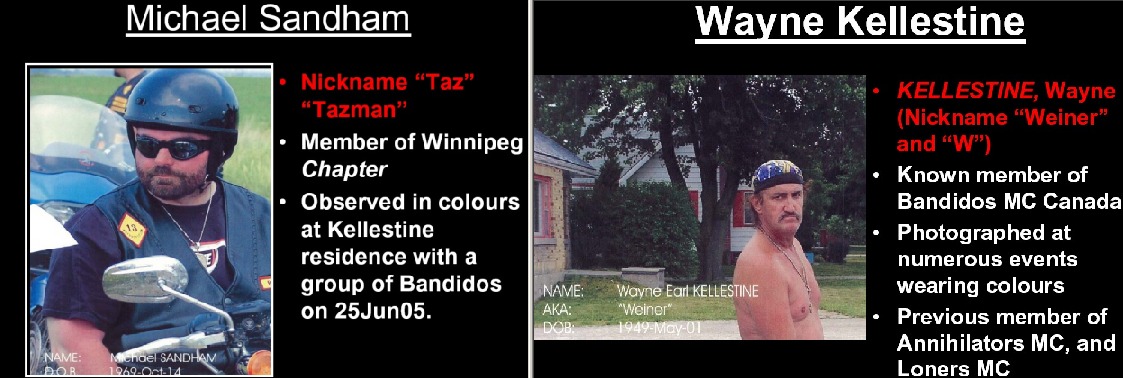
But they were, like the Outlaws and Rock Machine before them, an annoyance to the Hells Angels and that made them a target. The primary suspect in the murder, Wayne "Weiner" Kellestine, is a longtime biker who formed his own gang, the Annihilators, in nearby St. Thomas in the 1970s. Later, as most Ontario bikers were choosing sides between the Outlaws and Hells Angels, Kellestine opted for the non-aligned, Toronto-based Loners. While on his way to a friend's wedding in 1999, he was shot at by two Hells Angels prospects but survived. In 2001, when the Hells Angels took over the Loners, Kellestine joined the fledgling Bandidos.

Now he is in jail awaiting trial for the murder of eight men -- six full-patch Bandidos, another a Bandidos prospect and the other a known associate. According to police, this isn't the first time the Bandidos have cleaned house by killing off undesirable members, nor is it something the Hells Angels are above.

But the few Bandidos were the last remaining obstacle to Hell Angels' hegemony in Ontario. While the Hells Angels -- who hastened to proclaim their innocence -- may not have blood on their hands, they can't be too upset about the elimination of what little competition they had left.

Saturday, July 10, 2010

Slain biker 'prospect' hailed from Cote St. Luc


Slain biker 'prospect' hailed from Cote St. Luc

One of the eight victims of Ontario's worst mass murder grew up in Montreal and will be buried here tomorrow.

By The Gazette (Montreal) April 12, 2006

One of the eight victims of Ontario's worst mass murder grew up in Montreal and will be buried here tomorrow.

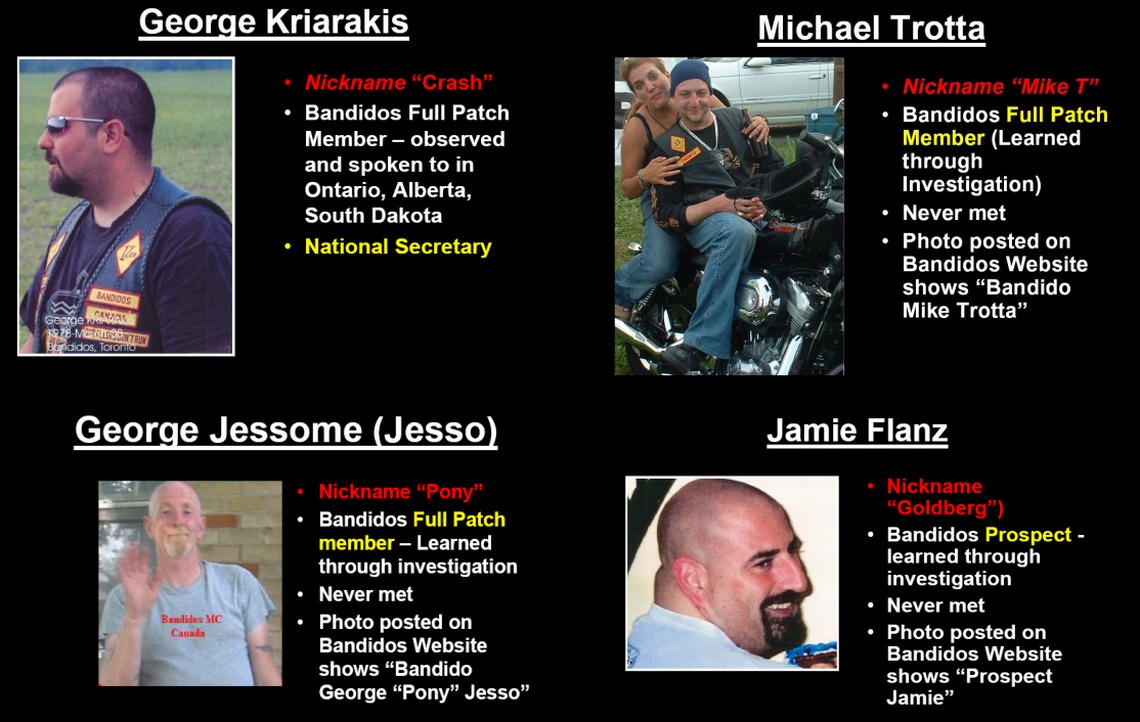
Jamie Flanz, 37, a resident of Keswick, Ont., was among the eight people tied to the Bandidos outlaw motorcycle gang killed as a result of what the Ontario Provincial Police described as an internal conflict within the gang.

Leonard Flanz, a Montreal lawyer, said he had difficulty believing his son was a prospect in a biker gang. "It just doesn't fit the image of Jamie.

"He did affect the image of the motorcycle crowd, but not that of a motorcycle gang. He had a Harley-Davidson and liked to wear a leather jacket and shades. He was a big guy. But as is often the case, image is not the reality.

"There were an awful lot of positive things about Jamie."

Flanz was not known to police investigators who probe biker activity in this province. Flanz did not have a record in Quebec.

But police recently searched Flanz's home in Keswick, about 50 kilometres north of Toronto, for evidence in the beating death of a man whose body was found in a woodlot in Pickering, Ont., four months ago. No charges were laid against Flanz, and police are still investigating.

Flanz was described by Ontario police as a "prospect" of the Bandidos. That status meant he was one step away from being a full-fledged or "full patch" gang member. Shortly before he was killed, according to the Globe and Mail, Flanz had told a friend he had plans to leave the gang.

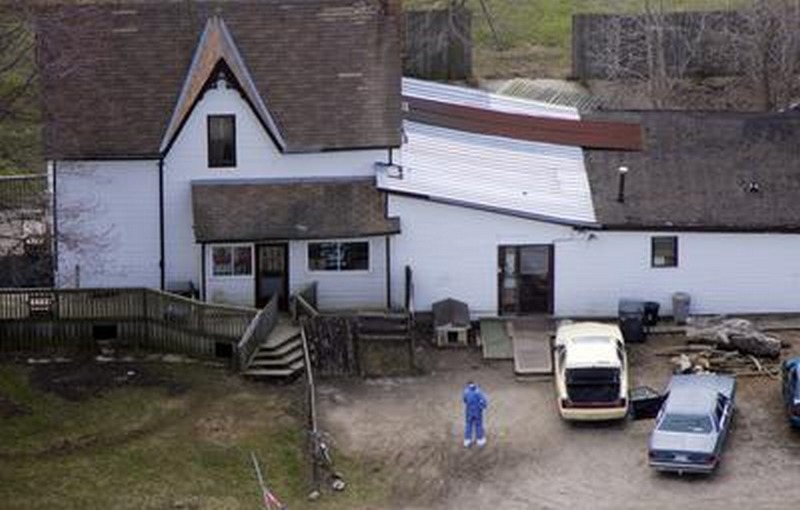
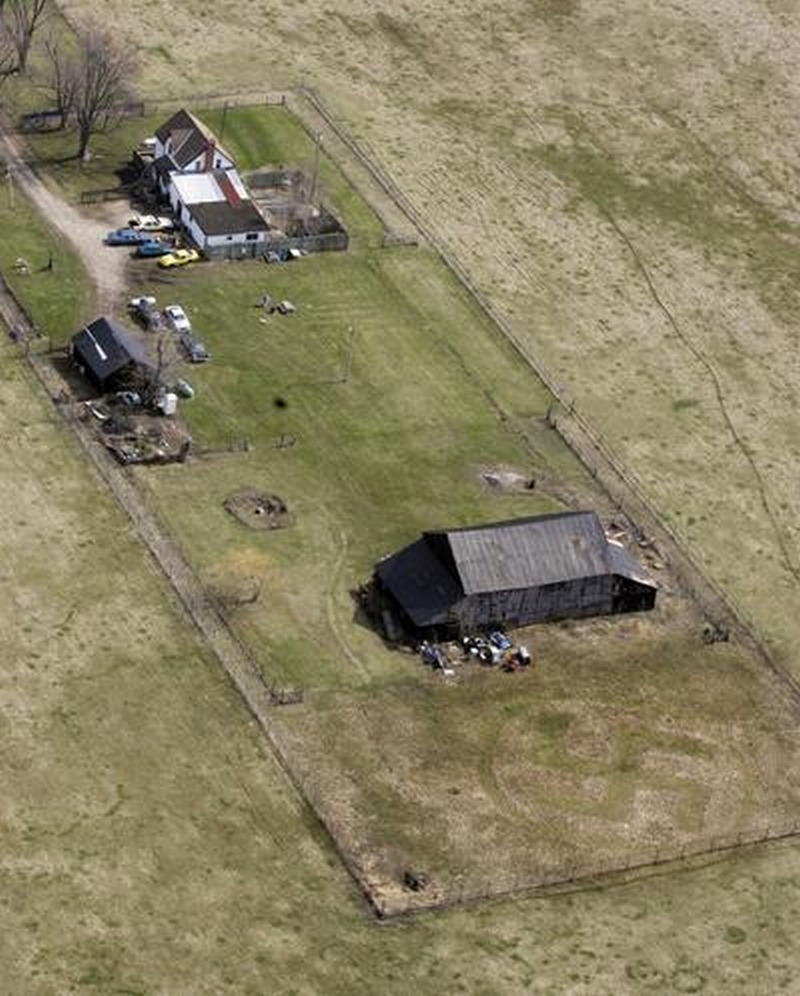
Aerial photos taken Sunday of the area where the eight men were found Saturday showed Flanz's luxury SUV abandoned with its hatch open and a large man in pyjamas lying dead in the back.

The OPP would not confirm whether the body pictured was that of Flanz.

Flanz grew up in Cote St. Luc with his two younger sisters and a younger brother.

He graduated from Wagar High School and attended Dawson College while playing hockey and baseball on teams in Cote St. Luc. He coached hockey and was an ambulance technician with Cote St. Luc's Emergency Medical Services.

His father said Flanz once saved the life of a man who had been shot at a bar in downtown Montreal. He was working as a bouncer at the time but used his life-saving skills to keep the man alive until ambulance technicians arrived.

"In many respects, he could have been a role model to many young people while he was growing up," Leonard Flanz said.

Jamie Flanz moved to Ontario nine years ago. He helped a U.S. computer services firm set up a Canadian company but left the job in 1999 and moved on to direct a Toronto company called Onico Solutions.

Leonard Flanz said he spent weeks with his son this year in Florida. They were in regular contact when they returned and, Flanz said, he spoke to his son on Friday, presumably just hours before the homicides occurred.

Flanz said his son did not express any concerns about his personal life.

The slayings, and the arrest of a full patch member as one of the suspects, have generated media speculation that the Bandidos are on the verge of disappearing in Canada. The international biker gang, which originated in Texas, has several chapters in many countries. But the Bandidos are "steering clear" of the funerals for the slain former members, Texas police said.

"When they have a funeral for a Bandido here in Texas, they come from all over. They have Bandidos represented from all over the world," said a Bandidos specialist based in Houston.

The gang's decision not to rally supports the allegation by police in Ontario and Texas that the eight Bandidos were killed in a matter of "internal cleansing" after a deal cut between their gang and the Hells Angels that surrendered Canada to the Angels.

But Guy Ouellette, a retired Surete du Quebec investigator and an expert on biker gangs, said it's too early to write off the Bandidos in this country.

The gang's chapter in Toronto had 20 members, including those who were killed and Wayne Kellestine, the Bandido charged in the slayings, Ouellette said, citing recent analyses.

Several Bandidos serving lengthy sentences for drug trafficking and other offences related to Quebec's biker war might eventually join the chapter in Ontario when released, he said.

That option was part of a pact the Bandidos reached with the Hells Angels when the former agreed to shut their chapters in Quebec, Ouellette said.

Another slain Bandido with a Quebec connection was Luis Manny Raposo, 41, of Toronto, who was arrested during the Surete du Quebec's Project Amigo in June 2002. Although he spent more than a year in prison - and though several of his co-accused pleaded guilty or were convicted - Raposo was not brought to trial because, the prosecution said, the main police informant in the case refused to co-operate.

Thursday, July 8, 2010

Witness named biker as killer in home Invasion 28 Yrs Ago

Witness named biker as killer


04-15-2007


Accused Bandidos killer Wayne Kellestine was once named in court as the man who gunned down a Toronto clothier during a brazen home invasion 28 years ago.

But in spite of the dramatic courtroom accusation, Kellestine was never charged in the Toronto murder.

A senior Toronto police officer said at the time that the man's testimony was the only evidence against Kellestine.

Kellestine, one of five people charged after eight dead bikers were found 20 km from his farm on the weekend, was accused during a 1982 trial of fatally shooting John DeFilippo, 31, and wounding his father-in-law Vito Fortunato, then 53, in a 1978, North York home invasion.


BULLETS MISSED WIFE

Bullets just missed DeFilippo's wife and their infant son.

A one-time Kellestine associate -- a former London man whose role was to lure DeFilippo to the door by posing as a pizza delivery man -- was convicted of second-degree murder in the slaying and spent 10 years in prison.

The man, known as John Goodwin, testified that he came to Toronto with his drug supplier boss Kellestine for fun and had no idea the trip would end in murder.

He told his first-degree murder trial he was struggling with DeFilippo inside the door when Kellestine burst in and pumped bullets into DeFilippo and then into Fortunato.

He also testified that he had kept quiet in the four years prior to the trial because Kellestine had threatened him and his family.

"All my life I've grown up knowing that you don't squeal ... because squealers get killed," the man told a jury, which ultimately agreed with prosecutors that he was part of the killing anyway and should be convicted of second-degree murder.

"I didn't want to get killed and end up in a cornfield somewhere ... I had nothing to do with it. I'm innocent."

Kellestine, 56, himself a Bandidos bike gang member, and four friends -- Eric Niessen, 45, Brett Gardner, 21, Frank Mather, 32, and a woman, Kerry Morris, 56 -- face eight first-degree murder charges in the executions of six full-patch Bandidos, a prospect member and an associate.

Autopsy findings have still to be released in what OPP have said are the shooting deaths of John "Boxer" Muscedere, 48, Frank "Bam Bam" Salerno, 43, Luis Manny "Porkchop" Raposo, 41, George (Gus) "Crash" Kriarakis, 28, Paul Sinopoli, 30, George "Pony" Jesso, 52, Jamie Flanz, 37, and Michael Trotta, 31.

Their bodies were found, along with four vehicles, near the small Ontario hamlet of Shedden, about 20 km from Kellestine's Iona Station farm.
Contacted last night, the former London man who was convicted and imprisoned in DeFilippo's slaying said he still fears for his safety.

The man, who has moved elsewhere in Canada and keeps a low profile, maintained his innocence in the DeFilippo murder.

Library files show the man was 23 when he said he and his construction company boss Kellestine came to Toronto to collect a drug debt.

He testified he and Kellestine, then-owner of Triple-K Construction in London, met up with a man named "Mike" in Toronto and drove to Fortunato's home. DeFilippo and Fortunato were watching a hockey game when a man, posing as a pizza man, knocked on the rear door.


WRESTLED WITH HIM

The man testified at two trials - the first was declared a mistrial - that when he told DeFilippo "Mike" wanted to see him in the car outside, DeFilippo wrestled with him.

"He grabbed hold of me, knocked the pizza out of my hand and we sort of struggled ... I heard a bang, a gun, and he let go off me and fell down."

The man testified that "Mr. Kellestine came in shooting."


http://cnews.canoe.ca/CNEWS/Law/200...533068-sun.html

Saturday, April 24, 2010

MASSACRE A DRUG RIPOFF


MASSACRE A DRUG RIPOFF

The night started with the transfer of $400,000 worth of cocaine to Wayne Kellestine's farmhouse and it ended with Ontario's largest mass murder.

Hours before Ontario's largest mass murder, Durham Region police officers followed three of eight Bandidos from the Toronto area to a southwestern Ontario farmhouse belonging to the man now charged with killing them, sources have told the Toronto Star.

Suspecting a major drug deal could be in the works, investigators tailed the trio west along Highway 401. But they were unaware the men were transporting a cargo of 200 kilograms of cocaine that night to fellow Bandido Wayne ( Weiner ) Kellestine's London-area farm, law enforcement sources say.

After watching the three men enter the farmhouse, the officers left, assuming the bikers were there for a party, the source said.

What transpired was a deadly drug ripoff that left the three Bandidos shot dead, their bodies stuffed into cars that were driven into a field. It's believed five other Bandidos arrived separately later that night, only to be systematically killed and their bodies similarly disposed of.

It's unclear whether the ripoff of $400,000 worth of cocaine was planned. It's believed the killings were going to be justified to fellow bikers as punishment for refusing to participate in a national "run," an outlaw motorcycle tradition involving members riding in formation according to club hierarchy.

Four others, including a woman, were each charged with eight counts of first-degree murder. They were to appear in a St. Thomas courtroom today.

More details, meanwhile, are emerging about Kellestine, who relished playing the role of a dangerous man.

The 56-year-old loved to pose in front of his collection of Nazi memorabilia in his rundown farmhouse, near Dutton, about a 20-minute drive from where police discovered the bodies of eight Toronto-area members of the Bandidos motorcycle gang on the weekend.

"His reputation is being an absolute renegade," said someone from the area who knows him well. "A dangerous, dangerous guy. He's always had that reputation."

Michael Simmons, who worked undercover for the Mounties and the OPP against motorcycle gangs 15 years ago, said he purchased cocaine and guns from Kellestine on several occasions and that his work helped put away 18 bikers, including his own brother, Andrew "Teach" Simmons -- onetime president of the Outlaws.

"I witnessed him shoot his girlfriend in the back with an air pistol just for a joke," said Simmons, who entered the witness protection program in 1992. "He pointed a .45-calibre at my big toe and asked me if I could blow it off, when I was trying to buy some cocaine off him."

On another occasion, Simmons said he witnessed Kellestine "come flying down the stairs" in a combat arctic suit, armed with an Uzi, after a motion detector was set off on his rural property during a party.

"There was a big party and he freaked out, went upstairs, and he was down and ready for full combat, and that scared the s--- out of me," Simmons recalled.

Before Kellestine was sentenced to two years in prison in 2000 for weapons offences and running a marijuana operation, the court was shown photos of him posing with his personal arsenal, which included machine guns and Luger pistols like those the Nazis used.

"He always had lots and lots and lots of guns," the person who knows him well said. "He had quite an arsenal of guns."

Kellestine loved to dress the part of a dirty biker, with lots of leather. But in court, he tried to dress like former New York City mobster John ( the Dapper Don ) Gotti.

"He always wore a three-piece suit to court," said the person who knows him well. "When he came to court, he presented himself as a professional gangster."

Kellestine was president of his own local bike gang, the Annihilators, which evolved into the Loners and was affiliated with Toronto-area Loners.

That group eventually evolved into the Bandidos, and Kellestine remained a member.

While considered a dangerous force in southwestern Ontario, he wasn't on the level of those in bigger bike gangs such as the Outlaws and Hells Angels, the person who knows him well said.

"He was never in with them," the person said. "He stuck with his own crowd. ... He's always been a renegade kind of guy."

Billy Miller, who was once part of the Loners with Kellestine, went on to become president of the London Hells Angels.

Kellestine's houseguest, Frank Mather, 32, is a far different man. He has a lengthy criminal record that includes eight break-and-enters but no violence. He served a three-year term in prison in his native New Brunswick and was on parole for possession of break-and-enter tools when arrested while trying to steal a truck.

He has never been a biker, and his consistent record of arrest suggests he would be a liability to any organized-crime group.

"He'd be a follower, not a leader," said someone from the area who knows him.

He did land a six-month sentence in 2002 for growing marijuana near London, and was convicted again in 2005 for possession of break-and-enter tools.

The person who knows Mather's criminal activity well said he can't see him taking the lead in any kind of organized-crime hit.

"It's not his play," the person said. "Frank Mather is no biker."

Guy Ouellette, a retired Quebec Provincial Police biker expert, said the Bandidos were irritating for the Hells Angels in southwestern Ontario.

He said it's too easy to pronounce the Bandidos dead, even though they have only a dozen members in Toronto -- who meet in a Parkdale social club -- and five members in Manitoba with a puppet club called Los Montoneros.